- A splint first to control swelling and pain. A splint first to control swelling and pain.
- Closed reduction, gently guiding shifted bone back into position without an incision, foll. Closed reduction, gently guiding shifted bone back into position without an incision, followed by a cast, when the alignment can be restored and held.
- A cast or brace for several weeks while the bone heals, with repeat X-rays to confirm it s. A cast or brace for several weeks while the bone heals, with repeat X-rays to confirm it stays aligned.
- Hand therapy after healing to restore motion and strength. Hand therapy after healing to restore motion and strength.
- Surgery to realign and secure the bone with plates, screws, or pins is considered when the. Surgery to realign and secure the bone with plates, screws, or pins is considered when the break is displaced, unstable, or involves the joint surface in a way that casting cannot hold.
What is Distal Radius (Wrist) Fracture?
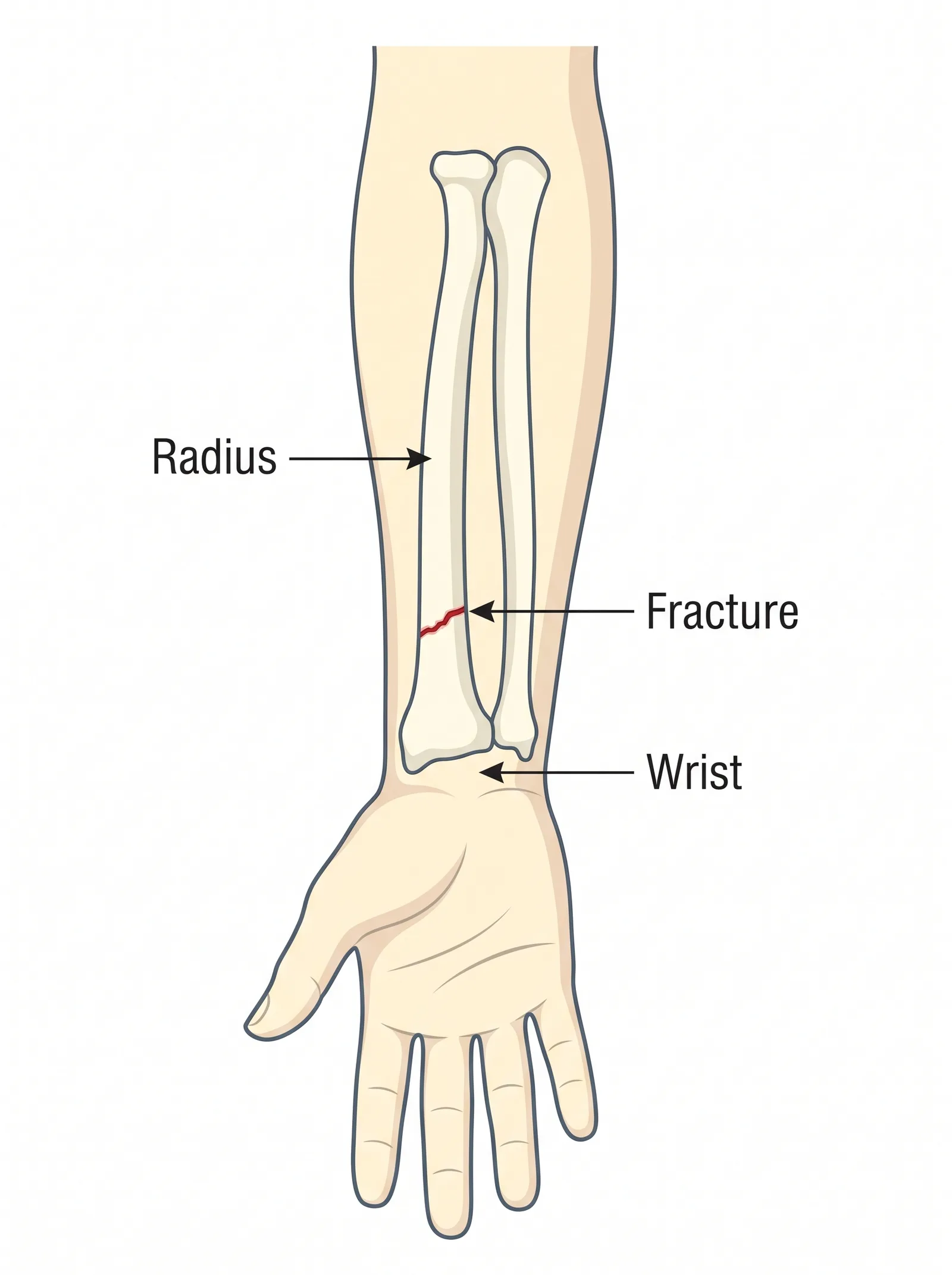
The distal radius is the end of the larger of your two forearm bones, right at the wrist.
It is the most commonly broken bone in the arm. Most breaks happen when someone falls and lands on an outstretched hand. A wrist fracture causes sudden pain, swelling, and often a bent or crooked look to the wrist. Moving the hand and wrist is painful, and gripping is hard. Numbness or tingling in the fingers can happen if the swelling presses on nearby nerves. How a fracture is treated depends on whether the bone pieces have shifted out of place, how many pieces there are, and whether the break involves the joint surface. Your age and activity level also matter.
How is Distal Radius (Wrist) Fracture diagnosed, and what does the visit involve?
Wrist fractures are diagnosed with an exam and X-rays.
X-rays confirm the break and show whether the bone pieces have shifted or entered the joint surface. For complex breaks, a CT scan, a detailed cross-section image, may be used to plan treatment. Your physician also checks the nerves and circulation in the hand, since swelling near the fracture can affect them.
What is recovery like for Distal Radius (Wrist) Fracture?
Bone healing commonly takes about six weeks, though full recovery of motion and strength takes longer, according to general guidance from the American Academy of Orthopaedic Surgeons.
These are ranges, not promises. Stable fractures treated in a cast are rechecked with X-rays to be sure they stay aligned. After the cast comes off, hand therapy helps restore movement. Your physician will map your specific timeline.
Who treats distal radius (wrist) fracture in Memphis?
Jeff Cole is a orthopedic surgeon who treats distal radius (wrist) fracture in Memphis, TN. Fellowship trained at Washington University / Barnes-Jewish Hospital. Dr. Cole sees patients at the practice in Memphis; appointments can be requested through this site.
Common questions
Do all wrist fractures need surgery?
How long will I be in a cast?
Why does my hand feel numb after a wrist fracture?
When should a wrist injury be seen right away?
Educational information only. This page does not replace an examination or medical advice.
Reviewed by Jeff Cole
Fellowship trained at Washington University / Barnes-Jewish Hospital. Sees patients in Memphis.